About
The first complete free, open-source translation of the Dead Sea Scrolls.
Read the source transcription and machine-draft English together. Translation suggestions enter a shared public desk; editors review them for later releases.
 Cohere
Built with a Cohere compute grant
Open Dead Sea is the product of a generous compute grant from Cohere AI.
Our goal
Our goal is a completely free, open-source project producing an English translation of all 53,568 currently transcribed source-text lines in the Dead Sea Scrolls manuscript catalog, for research. Today, 53,479 English machine-draft reading-aid lines are published. A machine draft is never the finished translation.
LLMs alone do not provide the controls required for translation of the highest quality. We ground and test their output against Macula Hebrew, ETCBC/dss's Abegg diplomatic transcriptions of Hebrew and Aramaic manuscripts, and the lexical features of ETCBC/BHSA 2021. These are defined reference points for testing a draft, not a substitute for the wording of a Qumran witness.
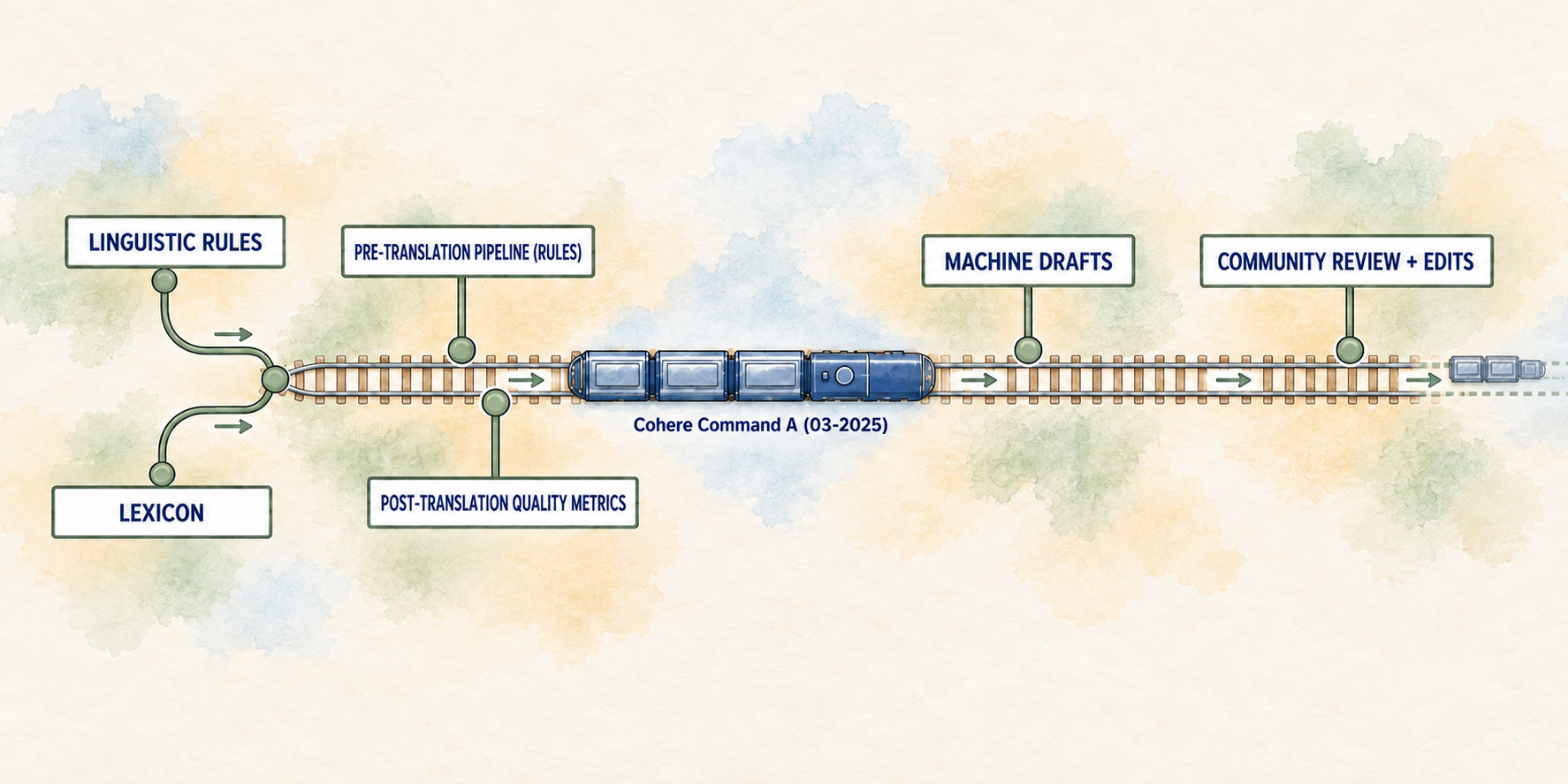
Click or tap the image to zoom.
Community review
Every machine draft remains a draft. Readers may suggest changes in the spirit of Wikipedia, but the process takes an open-source-software and GitHub-like form: suggestions can be discussed publicly and must be approved by editors before they become part of a release.
How to take part
-
Read freely
No account. Open manuscripts, machine drafts, source links, and public translation suggestions.
-
Verify to contribute
Sign in with GitHub, then submit relevant experience and a contact method for editorial verification before making requests or comments.
-
Follow editorial decisions
Verified contributors can discuss requests in public. Editors record decisions and manage account access.
Download and share
Open Dead Sea is a project of Jesus People SF and Apocalypse Press. You may download the public manuscript and English-draft dataset and share it under the Creative Commons Attribution–NonCommercial 4.0 International license. Please credit Open Dead Sea, Jesus People SF, and Apocalypse Press, and retain required attribution to the upstream sources.
Cite Open Dead Sea
Use one of these templates only when citing Open Dead Sea's English translation dataset. Include the manuscript or line URL as well when your work depends on a particular reading.
Open Dead Sea. (2026). Open Dead Sea: English translation dataset of the Dead Sea Scrolls [Data set]. Jesus People SF and Apocalypse Press. https://opendeadsea.org/
Open Dead Sea. Open Dead Sea: English Translation Dataset of the Dead Sea Scrolls. Data set. Jesus People SF and Apocalypse Press, 2026. https://opendeadsea.org/.
Open Dead Sea. Open Dead Sea: English Translation Dataset of the Dead Sea Scrolls. Jesus People SF and Apocalypse Press, 2026, https://opendeadsea.org/.
@dataset{opendeadsea_2026,
  author = {{Open Dead Sea}},
  title = {Open Dead Sea: English Translation Dataset of the Dead Sea Scrolls},
  year = {2026},
  publisher = {Jesus People SF and Apocalypse Press},
  url = {https://opendeadsea.org/},
  note = {Creative Commons Attribution-NonCommercial 4.0 International}
}
Hebrew and Aramaic sources
The original-language wording comes from two public Text-Fabric repositories. Both are CC BY-NC 4.0. Full notes: ETCBC/dss and ETCBC/BHSA. How this site uses them: the Sources document in the repo (docs/SOURCES.md).
-
ETCBC/dss
Diplomatic transcription of the scrolls. Martin G. Abegg, Jr.; CACCHT; Eep Talstra Centre for Bible and Computer. This is the Hebrew, Aramaic, and rare Greek wording on each manuscript page.
Wording -
ETCBC/BHSA 2021
Biblical Hebrew lexeme and gloss features. Eep Talstra Centre for Bible and Computer. Lexical grounding for later translation work. A BHSA gloss is not the English of a Qumran line.
Lexical grounding -
Macula Hebrew
Reference-text syntax diagrams from Clear Bible. Provides morphology, syntax trees, and semantic roles for the Masoretic Text as a grammatical reference; not the Qumran transcription itself.
Syntactic reference
Greek sources and semantic framework
-
Macula Greek
Greek reference framework in our Bibla Lingua tooling from Clear Bible. Combines lemmas, morphology, syntax trees, semantic roles, and participant references. Word-sense data includes the United Bible Societies' MARBLE project, based on Louw–Nida semantic domains. Attribution: MACULA Greek Linguistic Datasets, CC BY 4.0.
Syntactic reference -
Greek Dead Sea Scrolls wording
Greek Scrolls wording comes from the transcription or printed edition named on each manuscript page, including the Discoveries in the Judaean Desert editions. Macula Greek has not yet been mapped word for word to these witnesses and is not a Septuagint annotation of them. The Greek edition-based drafting workflow uses Cohere Command A for English candidates and Command A+ for a fidelity audit; these remain machine drafts for human review.
Wording -
Coverage note
Macula Greek currently annotates the Greek New Testament (SBLGNT and Nestle 1904). Where a Greek manuscript page offers a Hebrew reference diagram, it shows Macula Hebrew syntax for the corresponding Masoretic verse and does not describe the grammar of the Greek manuscript.
Reference diagram
Planned public-domain glosses for this site are BDB 1906 and Jastrow 1903. Leon Levy and the Israel Museum are outbound photograph viewers only.